
You have been looking forward to it for months.
Then you get to the hotel, put the cases down, and realise you can barely straighten up. The first evening is spent gingerly, and the first day is spent recovering rather than enjoying yourself.
A travel day asks a surprising amount of a back, and almost all of it is avoidable with a bit of planning.
What a travel day actually involves
Think about the sequence.
A late night packing, frequently after a day at work.
An early start.
Lifting cases into a car boot, bending and twisting with the heaviest thing you own.
Sitting for a long stretch, in a seat you did not choose.
More lifting at the other end, usually when you are tired.
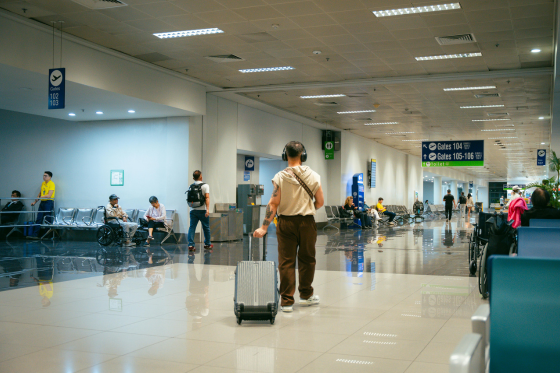
Walking considerably further than usual through terminals, with a bag.
And a hire car, a transfer or another drive to finish.
Each of those is tolerable on its own. In sequence, on the same day, for a back that is already a bit grumpy, it adds up.
The sitting part
For a great many people with back pain, sitting is the most provocative position there is.
The reasons are straightforward. Sitting increases pressure through the lower back, it puts the spine into a sustained flexed position, and it removes the regular movement that keeps things comfortable.
Then you do it for four hours without moving.
What helps.
Get up. This matters more than anything else about your seat. On a flight, walk the aisle every forty five minutes or so. On a drive, stop more often than you would otherwise, even if it adds half an hour. Two minutes of movement resets things considerably.
Move in your seat. Shift your weight, change leg position, roll your shoulders, do a few gentle pelvic tilts. It is not as good as getting up and it is far better than nothing.
Support your lower back. Aircraft and car seats are frequently shaped in a way that encourages your lower back to round. A rolled jumper, a small cushion or an inflatable lumbar support in the curve of your back makes a real difference. Take one rather than hoping.
Get the seat position right before you set off rather than once you are uncomfortable.
And if you can choose, an aisle seat makes getting up considerably easier, which means you will actually do it.
Luggage
This is where a lot of travel day backs actually go.
Pack lighter. The simplest fix and the one nobody takes. Most people return having worn half of what they brought.
Use wheeled cases, and pull rather than carry wherever possible.
Split the load. Two medium cases are kinder than one enormous one, particularly for lifting.
Mind the boot. Lifting a heavy case out of a car boot involves reaching forward over the bumper with the weight held away from your body, frequently with a twist. That combination is the classic one, and it is where a lot of people hurt themselves.
Get the case to the edge of the boot first, then lift it from close to your body rather than at arm’s length. Turn your feet rather than twisting your back.
And ask for help with the genuinely heavy things, including at the airport. It is not giving in.
The overhead locker
A specific one worth naming.
Lifting a heavy bag above shoulder height, in a narrow space, while standing in an awkward position, with people waiting behind you.
If your bag is heavy enough that this is a struggle, it is too heavy for a cabin bag. Either lighten it or ask the cabin crew, who are asked this constantly.
The week before
Something that catches people out every year.
A great many people do a great deal immediately before going away. The big garden tidy. Clearing the house. Finishing a project at work. Moving furniture so the person feeding the cat can get in.
Then they get on a plane the next morning.
If your back has been fine and you want it to stay that way, the week before a trip is not the time to take on a load of unusual physical work.
Spread it out, or leave it.
Arrival day
Once you are there.
Do not unpack everything standing bent over a suitcase on the floor. Put the case on a bed or a luggage rack.
Go for a short walk. Movement after a long journey does more than lying down.
Do a few gentle movements, whatever you normally do.
And resist the urge to do something ambitious on day one. The temptation is to start the holiday properly, and a back that has just had a travel day usually does better with an easy first day.
If you already have back pain
A few extra things.
Take your medication in your hand luggage, in adequate quantity, with a copy of your prescription if you are going abroad.
Take whatever you use for support or comfort rather than assuming you will manage.
Keep doing your exercises. People stop on holiday, which is precisely when their back is dealing with unfamiliar beds and unusual activity.
Consider booking an aisle seat and building in more time so you are not rushing.
And have a plan for a flare. Knowing what you would do, and what you would take, is worth more than hoping.
Symptoms that need urgent attention
Some things need medical attention rather than managing.
Go to A&E immediately for numbness in the groin, genitals or inner thighs, new difficulty controlling your bladder or bowels or starting to pass urine, or weakness in both legs.
Seek prompt medical assessment for progressive weakness in a leg or foot, a foot that drops or catches when you walk, back pain with fever, unexplained weight loss or night sweats, severe unrelenting night pain that does not vary with position, or back pain following a significant fall.
And a travel specific one. Calf pain with swelling, warmth or redness after a long flight needs urgent assessment, since it can indicate a clot. Seek emergency care if that comes with breathlessness or chest pain.
Sort it out before you go
The best time to deal with a back that has been grumbling is several weeks before you travel, not the week you get home.
Ed Voss Physio offers a free discovery visit at no cost and no obligation. You will get a thorough assessment, an honest explanation of what is actually going on, and a plan that gets you to the airport in better shape than you are now.
And if you have a trip coming up, we can go through the specifics of your journey and what would help.