
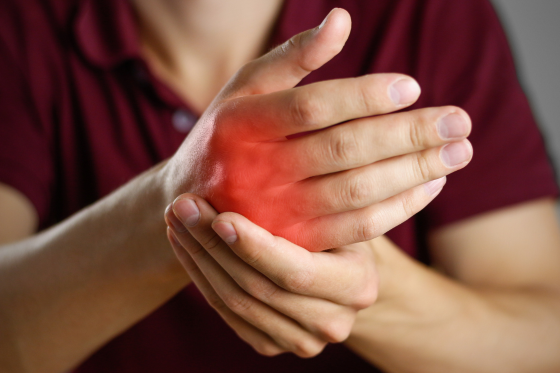
Arthritis of the knee or hip announces itself. It affects walking, and walking is visible.
Hand arthritis is quieter. It doesn’t stop you leaving the house. It just makes about forty small things a day slightly harder, and then progressively harder, until you’ve reorganised a surprising amount of your life around it without ever quite deciding to.
Here it is by the tasks, because that’s how people actually experience it.
The Jar Lid
What’s happening: Opening a jar requires a firm grip combined with rotation, and the load concentrates at the base of the thumb — where the thumb meets the wrist.
That joint is one of the most commonly affected sites of osteoarthritis in the hand. It’s a saddle-shaped joint built for an unusual amount of mobility, and mobility is traded against stability. It’s also loaded far more heavily than people realise: pinching generates forces at the joint several times greater than the force at your fingertips.
Who tends to get it: it’s notably more common in women, and typically appears from around the fifties onwards.
What tends to help: joint protection strategies and adaptive equipment. A jar opener is not a defeat — it’s removing an unnecessarily high load from an irritable joint several times a week.
The Key in the Door
What’s happening: Turning a key is a pinch grip with rotation — one of the most demanding things you ask of the thumb base for its size.
What tends to help: a key turner, or simply a larger keyring that lets you use more of your hand rather than a fine pinch. Small changes to leverage make a genuine difference to joint load.
The Kettle
What’s happening: Lifting a full kettle loads the thumb and wrist while the arm is extended, which is a poor combination.
What tends to help: filling to what you need rather than to the top, using two hands, or switching to a lighter kettle. Again, this is load management rather than giving in.
Buttons, Zips and Jewellery Clasps
What’s happening: These need fine pinch and dexterity, and they’re often the tasks people find most frustrating because they’re tied to independence and getting out of the door.
Where the pain usually is: the small joints of the fingers, which can develop bony thickening at the joints — familiar to many people as knobbly finger joints.
What tends to help: button hooks, larger fastenings, front-fastening clothing, and adapted zip pulls.
Writing and Using a Phone
What’s happening: Sustained pinch grip on a pen, or repeated thumb use on a screen, loads exactly the structures already irritable.
What tends to help: wider-barrelled pens, which reduce the pinch force required. Using a different digit or voice input on a phone. Breaking up sustained tasks rather than doing them in long blocks.
Chopping and Cooking
What’s happening: Grip plus force plus repetition. Cooking is often where people first notice they’re avoiding things.
What tends to help: larger, softer-handled utensils, sharper knives — a sharp knife requires considerably less force — and a food processor for tasks that used to be done by hand.
Getting Up From a Chair
Worth including because most people don’t connect it.
What’s happening: Pushing up from armrests puts significant load through the wrists and thumbs. People with hand arthritis frequently develop pain here without ever linking it to the hand.
What tends to help: pushing through a flat palm rather than gripping the arms, or using leg strength and momentum instead.
What Actually Treats It
Beyond adapting individual tasks, three things carry the most weight.
Exercise, as core treatment. UK guidance is clear that therapeutic exercise is a core treatment for osteoarthritis, including muscle strengthening tailored to the affected area. For the hand that means strengthening around the thumb base and the small muscles of the hand, alongside maintaining range.
A word about grip strength: it’s tempting to avoid gripping entirely when it hurts. That reliably reduces capacity, and reduced capacity means the same tasks represent a larger share of what you can manage. Loading needs to be appropriate rather than absent.
Splinting. Splints for the thumb base are widely used and many people find them genuinely helpful, particularly for supporting the joint during demanding tasks or overnight. Fit matters considerably — an ill-fitting splint that’s uncomfortable simply won’t be worn.
Joint protection. This is the principle running through everything above: use larger joints where you can, spread load across more of the hand, reduce sustained grip, use leverage and equipment, and break up repetitive tasks.
On Medication and Injections
Briefly, and with the same caveat as always — these are GP conversations, not decisions to make from an article.
Current UK guidance places topical anti-inflammatory preparations ahead of oral ones where medication is needed, and notes there’s no strong evidence of benefit for paracetamol in osteoarthritis, advising against offering it routinely. It also advises against glucosamine.
Steroid injections may be considered when symptoms aren’t controlled otherwise, with the understanding that relief is likely to be short-term.
If you’ve been taking something daily for years, that’s worth reviewing with your GP rather than continuing by default.
The Thing Worth Saying
There’s a version of hand arthritis where someone gradually stops doing things — cooking properly, gardening, a craft they enjoyed, playing an instrument — and never mentions it, because none of it is dramatic and it happened one task at a time.
That gradual narrowing is worth taking as seriously as the pain, because it’s the part that actually affects quality of life. And it’s frequently more addressable than people assume.
When to See Your GP
Book an appointment for morning stiffness in the hands lasting well over an hour; several small joints swollen symmetrically in both hands; symptoms that improve with movement and worsen with rest; joint pain alongside fatigue, feeling unwell, weight loss or rashes; or any personal or family history of psoriasis with joint symptoms.
Why this matters here particularly: rheumatoid arthritis characteristically affects the small joints of the hands symmetrically, with prolonged morning stiffness — and it needs early diagnosis and entirely different treatment, because joint damage in inflammatory arthritis can be permanent and much of it occurs early.
Seek same-day assessment for a joint that’s hot, red and acutely swollen, particularly with fever.
Also worth mentioning numbness or tingling in the hand, which suggests nerve involvement rather than joint arthritis, and needs distinguishing.
Let’s Look at Your Hands Properly
Hand arthritis responds well to a combination of strengthening, splinting where appropriate, and practical adaptation — and most people have been offered none of it.
Ed Voss Physio offers a free discovery visit at no cost and no obligation. You’ll get a thorough assessment of your hand and thumb function, grip, and the tasks you’re actually struggling with, plus a plan combining exercise, joint protection and practical solutions.
If your presentation suggests inflammatory arthritis or anything needing GP review, we’ll tell you plainly and help you get there.