
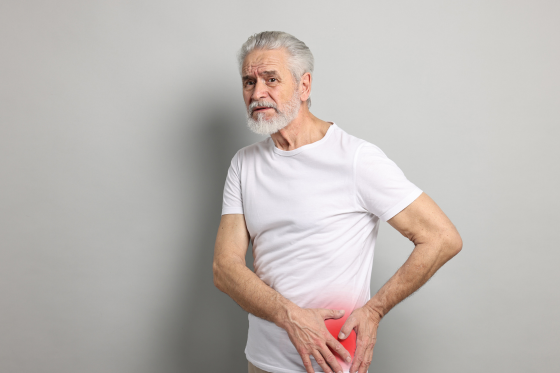
People with hip arthritis frequently spend months being treated for something else.
The reason is that the hip joint does not hurt where most people think the hip is.
Ask somebody to point to their hip and they will usually put a hand on the bony bit at the side, roughly where a trouser pocket sits. That is not where the joint is. The joint itself sits deeper and further forward, and when it is the source of the problem, the pain is most often felt in the groin.
Which is why a lot of people with hip arthritis are investigated for a hernia, or treated for a groin strain, or end up having their back treated for months with no improvement.
Where it actually hurts
The most characteristic location is the groin.
It can also be felt deep in the buttock, and it frequently refers down the front of the thigh toward the knee. A reasonable number of people with hip arthritis present complaining about their knee, with the hip never mentioned.
What it is less likely to be, if the joint is the problem, is pain confined to the outer side of the hip. That area is more commonly associated with the tendons that attach there, which is a different problem with different treatment.
There is also a gesture clinicians look out for. Asked to show where it hurts, people with a hip joint problem frequently cup the side of the hip with the thumb behind and the fingers into the groin, forming a C shape with the hand. They do it without being prompted, and it points toward the joint rather than the back.
The things that become difficult
The functional pattern is recognisable and it is frequently more telling than the pain itself.
Putting on socks and shoes, particularly on one side. This is one of the earliest and most characteristic losses, and people adapt to it quickly without registering it as a symptom.
Getting in and out of a car.
Crossing your legs.
Stiffness after sitting, and difficulty getting going again.
Stiffness first thing in the morning that eases within half an hour or so.
Walking distance gradually shrinking.
A limp that has developed slowly.
And difficulty with stairs, particularly going up.
If several of those apply, the hip is worth examining regardless of where you feel the pain.
The test worth doing
The movement most reliably affected by hip joint arthritis is rotating the hip inwards.
To get a rough sense of it, lie on your back, bend one hip and knee to a right angle, and have somebody gently rotate your lower leg outwards, which turns the hip inwards. Compare the two sides.
A clear difference, particularly with discomfort felt in the groin at the end of the range, is meaningful.
It is not a diagnosis, and it is a considerably more useful piece of information than where you happen to feel the ache.
Why it gets confused with the back
Two reasons.
The first is that the two regions refer pain into overlapping territory. Hip problems and lower back problems can each produce symptoms in the buttock, the thigh and down toward the knee.
The second is that both conditions are extremely common in the same age group, and degenerative changes show up on imaging in both places in a great many people without symptoms. So a scan of the spine will frequently find something, and that something gets treated.
The simplest distinguishing feature is the groin. Hip problems commonly involve it. Back problems commonly do not.
The other is movement. If your symptoms change reliably with hip movements such as putting on socks or getting out of a car, that points to the hip. If they change reliably with back positions, that points to the spine.
And it is worth saying that plenty of people have both, in which case the useful question is which one is actually limiting you.
What helps
The core of it is movement and strength, and the evidence behind that is considerably stronger than for most of the things people try first.
Strengthening the muscles around the hip, particularly the glutes and the thigh, progressed properly over months rather than weeks. This is the thing that makes the most difference and it is the thing most people have never been given in a structured form.
It needs to be genuinely loaded. Light bands and high repetitions feel like effort and build very little. The last couple of repetitions of a set should feel hard.
Keeping the joint moving, within comfort, regularly. Hip arthritis responds badly to being protected, and stiffness compounds quickly.
Something aerobic that you tolerate. Walking, cycling, swimming and pool based exercise all suit different people. Cycling in particular is well tolerated by a lot of hips.
Managing load sensibly, which means modifying rather than stopping. Some discomfort during and after activity is expected. The measure that matters is how you are the following morning.
Weight management where relevant, which has a real effect on hip load and which is a conversation with your GP rather than an instruction from an article.
And pain relief, discussed with your GP or pharmacist, used to enable movement rather than to eliminate all sensation.
What about surgery
Hip replacement is a good operation and it helps a great many people.
It is generally considered when pain and limitation are significant despite proper non surgical management, and when the effect on quality of life justifies the operation and the recovery.
Two things worth knowing.
A scan showing arthritis is not on its own a reason for surgery. Those changes are extremely common and the decision rests on symptoms and function rather than on an image.
And arriving at an operation stronger and fitter produces a better recovery than arriving having protected the leg for two years. Which is an argument for doing the work now, whichever way things eventually go.
Things that are commonly tried and do less
Being straightforward.
Supplements aimed at joints are widely sold and the evidence behind them is considerably weaker than the marketing suggests. If you want to try something, discuss it with your pharmacist, particularly if you take other medication.
Rest, which reduces pain by removing load and also reduces the capacity that makes movement comfortable.
Stretching alone, which may feel good and does not build the strength that actually changes things.
And waiting for it to settle, which is what a lot of people do for years before seeking help.
When to seek medical assessment
See your GP promptly for.
Hip or groin pain with fever or feeling generally unwell, which needs urgent attention.
Unexplained weight loss, or night sweats.
Any history of cancer with new hip pain.
Severe unrelenting night pain that does not vary with position.
Hip pain following a fall, particularly if you cannot bear weight.
A sudden inability to weight bear.
Numbness, tingling or weakness in the leg.
Or hip pain in anybody taking long term steroids, which warrants assessment rather than watching.
And go to A&E for numbness in the groin, genitals or inner thighs, new difficulty controlling your bladder or bowels, or weakness in both legs.
Get the right joint assessed
If you have been treated for your back for months without improvement, and your pain includes the groin, it is worth having the hip properly examined.
At Ed Voss Physio, you will get a thorough assessment of your hip, your back and how you move, a clear explanation of which one is actually driving your symptoms, and a plan aimed at the right place.
If your presentation suggests you need imaging or a specialist opinion, we will tell you plainly.